The well regarded Economist Magazine recently put out a special report on entrepreneurship in troubled times. Many people perceive that a poor economy discourages innovations and new venture creation. This report highlights the opposite - a troubled economy can be a hot bed for innovative entrepreneurial activity. The written report can be found here and the audio interview with the author of the report can be found below.
Showing posts with label Trends. Show all posts
Showing posts with label Trends. Show all posts
Saturday, March 14, 2009

Friday, October 31, 2008
Trend Questions
 Trendwatching.com is a great website. The people at trendwatching use spotters all across the globe to monitor and report on the latest social and business trends. Their reports provide valuable and useful insight for any innovator, entrepreneur or marketer.
A few weeks back they asked people to email them trend-related questions. They have just released the aggregated Top 15 Trend Questions (and Answers).
Top 15 Trend Questions (and Answers) with links to the answers:
* Q15: “How do I spot and apply trends?”
* Q14: “What are good trend resources?”
* Q13: “What will be the next Facebook or Google?”
* Q12: “What’s next for
* Q10: "What trends are affecting
* Q9: “How do I know a trend isn’t just a fad?”
* Q8: “When is the right time to act on a trend?”
* Q7: “What are the trends in
* Q6: “Who sets trends?”
* Q5: “How do I become a (better) trend watcher?”
* Q4: “How much influence do trend watchers have?”
* Q3: “What is a trend’s life cycle?”
* Q2: “What’s going to be big in 2009?”
* Q1: “How is the financial crisis going to impact my business?”
Tuesday, November 27, 2007
Trends for 2008
Looking over the Horizon
I have always maintained that it is important for entrepreneurs and business leaders to be conscious of trends and changes in lifestyle and behavior that affect their industry in a direct or indirect way. Trends is is defined as follows:
One of the best websites for monitoring trends is tendwatching.com. They recently published: "8 TRENDS TO CAPITALIZE ON IN 2008" report. It is really worth taking the time to read this report if you want some insight into some of the ways consumers may think, act or respond in the year ahead. The report is filled with brilliant insights, great examples and cool pictures to illustrate ideas.
The 8 TRENDS TO CAPITALIZE ON IN 2008 are:
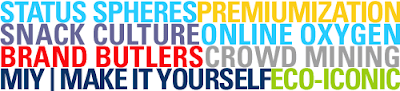
The brief idea behind each trend:
Status spheres - a variety of lifestyles, activities and persuasions, which can be mixed and matched by consumers looking for recognition from various crowds and scenes.
Pemiumization - no industry, no sector, no product will escape a premium version in the next 12 months.
Snack culture - he phenomenon of products, services and experiences becoming more temporary and transient; products that are being deconstructed in easier to digest, easier to afford bits, making it possible to collect even more experiences, as often as possible, in an even shorter time frame.
Online oxygen - control-craving consumers needing online access as much as they need oxygen.
Eco Iconic - Eco-friendly goods and services sporting bold, iconic design and markers, that help their eco-conscious owners to visibly tout their eco-credentials to peers.
Brand butlers - Think baby food or diaper brands opening a lounge area, including diaper-changing facilities and microwaves, for parents and their offspring at a major airport or in malls. Or a bank installing secure, high-tech lockers next to the beach, so beachgoers can safely store their belongings when going for a swim or walk.
Make it yourself (MIY) - having come to expect to be able to create anything they want as long as it is digital, and to customize and personalize many physical goods, the next frontier will be digitally designing products from scratch, then having them turned into real physical goods as well.
Crowd mining - when co-creating, co-funding, co-buying, co-designing, co-managing *anything* with 'crowds', the emphasis in 2008 will move from just getting the masses in, to mining those crowds for the rough and polished diamonds. How to do that? Shower them with love, respect and heaps of money, of course.
For all those taking a break in December, read this before you go as it will fuel your mind to consider out-the-box ideas as to how you could leverage off these trends for business success in 2008.
Here's how understanding trends may help:
I have always maintained that it is important for entrepreneurs and business leaders to be conscious of trends and changes in lifestyle and behavior that affect their industry in a direct or indirect way. Trends is is defined as follows:
Trends - directional tendencies in lifestyle, commerce or demographics. They may be obvious or imperceptible.
Euromonitor 2005
One of the best websites for monitoring trends is tendwatching.com. They recently published: "8 TRENDS TO CAPITALIZE ON IN 2008" report. It is really worth taking the time to read this report if you want some insight into some of the ways consumers may think, act or respond in the year ahead. The report is filled with brilliant insights, great examples and cool pictures to illustrate ideas.
The 8 TRENDS TO CAPITALIZE ON IN 2008 are:

The brief idea behind each trend:
Status spheres - a variety of lifestyles, activities and persuasions, which can be mixed and matched by consumers looking for recognition from various crowds and scenes.
Pemiumization - no industry, no sector, no product will escape a premium version in the next 12 months.
Snack culture - he phenomenon of products, services and experiences becoming more temporary and transient; products that are being deconstructed in easier to digest, easier to afford bits, making it possible to collect even more experiences, as often as possible, in an even shorter time frame.
Online oxygen - control-craving consumers needing online access as much as they need oxygen.
Eco Iconic - Eco-friendly goods and services sporting bold, iconic design and markers, that help their eco-conscious owners to visibly tout their eco-credentials to peers.
Brand butlers - Think baby food or diaper brands opening a lounge area, including diaper-changing facilities and microwaves, for parents and their offspring at a major airport or in malls. Or a bank installing secure, high-tech lockers next to the beach, so beachgoers can safely store their belongings when going for a swim or walk.
Make it yourself (MIY) - having come to expect to be able to create anything they want as long as it is digital, and to customize and personalize many physical goods, the next frontier will be digitally designing products from scratch, then having them turned into real physical goods as well.
Crowd mining - when co-creating, co-funding, co-buying, co-designing, co-managing *anything* with 'crowds', the emphasis in 2008 will move from just getting the masses in, to mining those crowds for the rough and polished diamonds. How to do that? Shower them with love, respect and heaps of money, of course.
For all those taking a break in December, read this before you go as it will fuel your mind to consider out-the-box ideas as to how you could leverage off these trends for business success in 2008.
Here's how understanding trends may help:
- Vision—Do these trends have the potential to influence or shape your company's vision?
- New business concepts—Can these trends point you to new business concepts, or entirely new ventures?
- New products, services, experiences—Can these trends inspire you to add 'something' new for a certain customer segment?
- Marketing, advertising, PR—Will these trends help you speak the language of those consumers that are already 'living' a trend?
Thursday, April 5, 2007
Riding the Wave: Global Trends
 Success in the business world can be compared to surfing: A surfer sits on their surf board behind the breaking waves staring out at the horizon watching for the next big wave. When they see a big wave building up they turn their board toward the shore, lie down and begin paddling to build some forward momentum so that when the wave reaches them, they can catch it and ride it towards the shore. The bigger and more powerful the wave the better the ride. To be successful in business one also needs to ride waves, these waves are called trends. As an entrepreneur one needs to be “looking over the horizon” for the next big trend and positioning oneself to ride the trend when it arrives. The bigger and more powerful the trend the more successful the ride.
Trends are directional tendencies in lifestyle, commerce or demographics. They may be obvious or imperceptible.
Here are some of the trends shaping the world around us:
West to East Power Shift: Economic power is shifting to Asia in terms of investment and output, with a growing “middle class” globally, but consumption remains driven by developed markets.
The Nub:
The percentage of manufacturing imports of high-income countries from developing countries had risen from under 15% in the 1970s to nearly 40% in 2003 and is projected to reach 65% in 2030.
Global output, on current trends, will double from 2005 to 2030; developing countries’ share will rise from 23% to 31%.
By 2030 over a billion people will form a new global middle class, around 16% of the world’s population versus 8% in 2000.
New Consumer Groups Emerging: Globally the population is becoming older, more urban and Asian, with increasing diversity as more people are on the move - new consumer groups are emerging, demanding more involvement in and customization of consumption experiences.
The Nub:
By 2015, there will be at least 750 million more people in the world, 97% of the increase will be in developing countries.
By 2050, 1 in 3 people in developed countries will be aged 60+, with 2 older people for every child (13).
A new generation of content-creating and publishing communities, e.g. YouTube, is driving new business models, as well as technical and environmental headaches.
In 2006, approx 161 billion gigabytes of digital information was created, captured and replicated – that’s more than 3 million times the information in all the books ever written.
Between 2006 and 2010 the amount of information added to the digital universe each year will increase sixfold.
War for Talent: A raging global war for talent for both skilled and “low cost” jobs is increasing. Asia continues to become increasingly important and outsourcing is on the rise within and across borders.
The Nub
By 2020 there will be 600 million more people active in the economy, mainly in the developing world – where labor costs will continue to be low, although increasing fast along with productivity.
Labor supply will generally shrink in the developed economies.
Low skilled workers will come under increasing pressure globally – the nature of work is shifting to require higher skills as businesses become more knowledge and service intensive.
Changing Geopolitical & Security Landscape: The networked global economy is being driven by rapid and largely unrestricted flows of information, ideas, cultural values, capital, goods and services, and people. Globalisation is enabling new dimensions of power beyond military might, including economics, resources and technology, but the new global landscape is not yet stable: risks and uncertainty are rising with the unrestricted flow of information. Regions, countries, and groups feeling left out and left behind will face deepening economic stagnation, political instability, and cultural alienation. This will foster political, ethnic, ideological, and religious extremism, along with the violence that often accompanies it.
The Nub:
Geopolitical instability is increasing – at the same time as trust in international institutions and the US is decreasing.
There are existing tensions between “old” and “new” powers e.g. between China and Japan, the US and Russia, India and Pakistan, based on history – and new ones emerging as the global economy shifts east, e.g. isolationist sentiment in the US.
Serious Resource Strain: Basic resources are under threat, including water, energy, food and habitats/climate as consumption rises faster than the planet can sustain it – public and institutional activism is rising. Al Gore and many others are raising awareness of the grave threat of global warming and slowly the response to these threats is gaining momentum in political, social and economic spheres.
The Nub:
Researchers estimate that in 2002 humanity was consuming ecological resources 23% faster than the Earth can replenish them.
The cost of climate-related events is growing: financial losses from weather-related disasters in 2005 were estimated as the largest ever at US$ 200 billion.
Changing Technology Landscape: A global technology revolution continues to evolve, crossing national borders and scientific disciplines – biotechnology, nanotechnology, media technology, mobile technology and information technology will continue to reshape industries and our daily lives.
The Nub:
By 2020, feasible technology applications include: widespread cheap solar energy using nanotechnology breakthroughs and mass-producible organic electronics, targeted drug delivery through molecular recognition and wearable computers
In just 12 years since the first GSM digital mobile network, telephones have been transformed into small but powerful multipurpose terminals. The future will bring further, revolutionary changes in this market.
Media technology will make everything personal, customized - it will transform the way we access, store and retrieve information.
In 2006, BAe announced the creation of an artificial surface that grips incredibly tightly without glue or pressure – inspired by the gecko’s ability to run up vertical surfaces.
Accountable or Nothing: Non state actors ranging from business firms to nonprofit organizations are playing increasingly larger roles in society. The stakeholders of such institutions are actively demanding transparency and accountability. The quality of governance will substantially determine how well organisation and societies cope with global forces and challenges. Corporations with ineffective governance will not only fail to benefit from globalisation, but may be vulnerable to major failures and financial downfall, ensuring an even wider gap between the eventual winners and losers.
The Nub:
The number of international NGOs with membership doubled from 1990 to 2003, to almost 300000.
Overall 67% of consumers in the US and Europe claim to have boycotted a food, drinks or personal care company's goods on ethical grounds.
Trust in global companies has fallen faster than for other institutions such as the UN from 2001 to 2005.
Open-sourcing Innovation and Knowledge Generation: Exploding connectivity and channels for information are making open-source innovation a global imperative – networking and linking in with broader knowledge and idea sources is critical, but gaining an edge and protecting knowledge is tough.
The Nub:
Surveys suggest R&D spending levels had no apparent impact on sales growth, gross profit, operating profit or market capitalization. The only relationship was to gross margin, but once non-operating costs were added in the link between spend and performance disappeared – “the R&D silo is succeeding in the traditional role of making “better mousetraps”… But these…aren’t catching more mice.” Only 10% of companies produce significantly better performance per R&D dollar compared to others in their industry.
P&G has succeeded by shifting from a R&D Strategy to a Connect and Develop Strategy i.e. a strategy in which they look outside the organisation for solutions and ideas as oppose to relying on just the R&D Dept.
Business Model Shifts: Business models are becoming global AND local, as shifting power along the value chain and the emergence of BRIC multinationals means more intense competition – innovation is critical to avoid being “stuck in the middle.” Companies are being forced to decide what they do and more importantly what they don’t do so as to create competitive advantage in relation to a much wider array of players.
The Nub:
In Europe by 2011 74% of adults will shop online versus 58% in 2006 – 176 million shoppers, up from 100 million.
Record levels of M&A are radically restructuring industries, with outbound deals from BRIC countries accelerating dramatically.
Fluid, extended network business models are taking over from “straight-line” value chain configurations – increasing complexity and pressure on margins.
References
These ideas are gleaned from:
1. Forty Key Trends for the Next Decade: 20 Key Global Trends and 20 Key Consumer Trends 2005-2015, Published: November 2005 Published By: Euromonitor International
2. World Bank Reports
3. IDC White Paper, The Expanding Digital Universe, March 2007
4. IMD Summary on Global Trends
Sunday, February 25, 2007
Trends to Take Note Of
On a recent 6 week tour across the USA, I paid close attention to the media and business fraternity to see if I could pick up on some of the major global trends emanating from with the worlds largest economy. After 6 weeks of reading the Wall Street Journal, NY Times and watching CNN and CNBC I picked up on some clearly evident trends that are going to have a major impact in 2007.
1. The Rise and Rise of Private Equity
As the traditional equity market cools off a little and investors yearn for higher and higher returns in more exciting investment vehicles, private equity has become the investment of choice. For investors, private equity offers good returns for solid investments in existing companies with solid track records. Most of these companies can get access to debt and with lots of debt and a small, well leveraged equity investment; the company can offer excellent returns over a 3 - 5 year time horizon. Businessmen like it because they are able to run their business in private. They are not subject to the public scrutiny that public companies face and they are able to just get on with the job of running the business without appeasing the media and analysts at every turn. 2006 was a mammoth year for the raising and investing of private equity funds in the USA and some of that money is now flowing to SA - Brait raised a fund in the USA and Edcon in being bought out by US Private Equity Players. Over time private equity will become a sought after asset class across the world and I predict that this will be followed by an increase of flows into venture capital once again (many people are over the bubble bursting hangover of the turn of the century and ready to explore the riskier asset classes once again)
2. Web 2.0 - It's an Individuals Game
Web 2.0 is fueled by Google, YouTube, MySpace and other sites that enable individuals to continually contribute to the web and express themselves in creative and interesting ways from videos to pod casts to blogs. Initially everybody thought the web was about facilitating transactions but slowly people are realizing that the web is about expression, it’s about empowerment and it’s about social networking. People are willing to share so much of themselves on the web and the more they share the more info marketers have to market appropriate products to them and the more the web becomes part of their everyday existence. Business people and venture capitalists are realizing if they can work out how to monetize this new trend of putting your life on the web, then they have a winning formula. Google worked out how to turn internet search into a profitable exercise, they have now purchased YouTube for 1.6 billion and need to work out how to turn online publishing (video; audio and text) into a profitable activity. To reinforce that that this trend is taking root, time magazine named you (an me and everyone else) their person of the year http://www.time.com/time/magazine/article/0,9171,1569514,00.html
3. Executive Pay - Make it Stop
The media and broader investing public are no longer going to put up with exorbitant CEO pay packages - especially when CEOs and other executives are under performing. There has been a huge backlash to the re-pricing of options to make them more attractive, the payment of huge severance packages for CEOs asked to leave and the inappropriate use of company assets for personal use. Bob Nardelli (Home Depot CEO) was the final nail in the coffin after weeks and weeks of bickering and complaining that CEOs are getting paid way too much for underperformance. I expect that directors deciding pay packages are going to have to be more accountable when options are re-priced and severance packages are declared. The media have declared war on the upper echelons of US business and they are now clearly in the spotlight for being overpaid.
Subscribe to:
Posts (Atom)


